This write-up first appeared in The Walleye (June 2021).
One of the most widely brewed beer styles on the earth is no other than the classic Pilsner. Some people estimate that pilsners account for 95% of global beer consumption. While craft beer fans of today often consider pilsners boring and relate them to the watery beers produced by industrial breweries, the Pilsner-style of beer making truly has been a raging hit with the widest range of people since it was first developed in the mid 1800’s.
A pilsner is a pale lager that takes its name from the Czech Republic city of Plzeň. Typically, at around 4.5% to 5% in alcohol by volume (ABV), pilsners are pale straw to golden yellow in colour and are hopped to various degrees. I personally think that when most people think of beer, they are thinking of the pilsner style.
The Pilsner has an interesting history that I can only briefly address here. It all started in 1838 in the Bohemian town of Plzeň. In this year, the town’s stores of ale had completely spoiled. This led to the brewers and the citizens revolting and dumping many barrels of beer into their main square in protest that their locally produced ale had become undrinkable. The citizens demanded that something be done about this. Working together, the town raised funds to build a new brewery (Burghers’ (Citizens’) Brewery) that incorporated some of the latest technologies of the Industrial Revolution: steam power and artificial refrigeration.
For this new brewery, the town also hired a brewer from Bavaria named Josef Groll. Groll came from a brewing family and brought with him two further advances in brewing technology: (1) Lager yeast from Bavaria that fermented at colder temperatures producing a cleaner tasting beer; and (2) Malt kilning techniques using coke (rather than wood) which produced much lighter-coloured malt (and thus lighter-colour beer). With these new brewing developments, combined with Saaz hops from Bohemia and clean soft well water from the town, Groll produced a delicious golden brew such as no one had ever seen before. People immediately fell in love with the Pilsener beer.
This new town brewery eventually started calling its beer Pilsner Urquell (which means “original source of pilsner”), which is still available today at most LCBOs. This approach to making beer became so popular that it eventually spread across the world leading several regional variations. See the table below for a breakdown of the different pilsner substyles.
Pilsner beers are notoriously difficult to brew due to their simplicity in ingredients. If you are interested in brewing one at home, this is a style you almost must focus more on your brewing techniques than the recipe itself. Because the brew is so simple, there is nowhere to hide any of your process mistakes. You will need to dial in your water chemistry to match the regional style you are trying to replicate. I personally love Pils from Northern Germany which has more of a bite from the high calcium sulfate levels. However, Lake Superior water is so soft and perfect for a Czech style pilsner.
If you are an all-grain homebrewer, make sure you use pilsner malt and consider step mashing (where the mash temperature is progressively increased through a series of rests). While a stepped approach is often not considered necessary with modern malts, carefully considering the schedule of temperatures can have a direct impact on fermentability, clarity, and head retention of your final beer. Furthermore, like with any lager brewing, make sure you pitch enough yeast and have tight control of your fermentation temperatures. This includes a diacetyl rest at the end of fermentation so that the yeast cleans itself up before you begin the lagering process.
This month when you are out camping or enjoying the summer weather, be sure to pick up a few different styles of Pilsner and try to learn which substyle you like best. Prost!
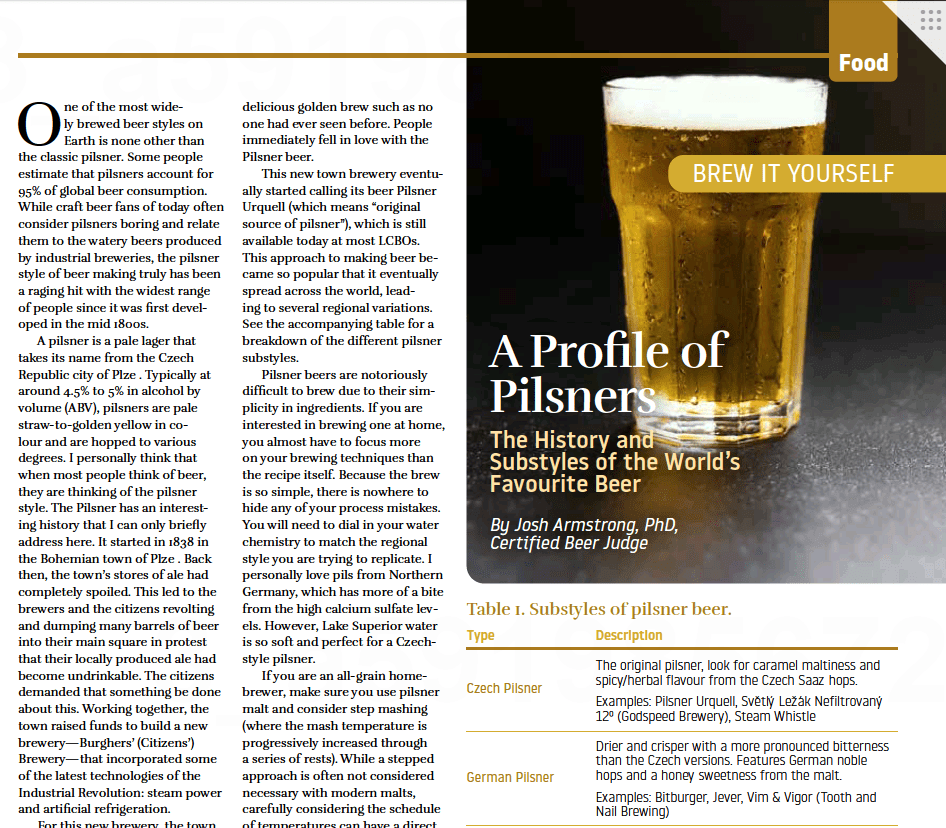
Table 1. Substyles of Pilsner beer.
| Type | Description |
| Czech Pilsner | The original pilsner, look for caramel maltiness and spicy/herbal flavour from the Czech Saaz hops. Examples: Pilsner Urquell, Světlý Ležák Nefiltrovaný 12º (Godspeed Brewery); Steam Whistle. |
| German Pilsner | Drier and crispier with a more pronounced bitterness than the Czech versions. Features German noble hops and a honey sweetness from the malt. Examples: Bitburger; Jever; Vim & Vigor (Tooth and Nail Brewing) |
| Italian Pilsner | Much like the German Pils, but with more European hop aroma from dry hopping. Examples: Glorioso (Left Field); Marco Polo (Indie Alehouse) |
| Eurolager | A broad category that is often not even considered to be a pilsner. Very much the equivalent of American macro-produced lagers but from Europe. Low on bitterness and typically finish sweeter that most pils. Examples: Heineken, Stella Artois, Grolsch |
| Classic American Pilsner | This style died out after prohibition in the USA and is often called “pre-prohibition lager”. These pilsners are often made with adjuncts found in America (corn, rice) along with old school American hops (Liberty; Crystal). Examples: Grass Roots (SGBC); Root of Evil (Whiprsnapr Brewing Co.) |
 Josh Armstrong, PhD